Text
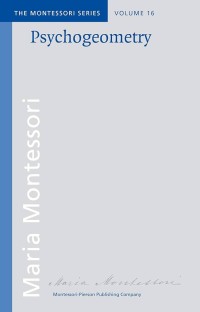
Psychogeometry
Translated into English for the first time nearly eighty years after its obscure 1934 publication in Spanish, "Psychogeometry" showcases the profound brilliance of Dr. Maria Montessori's mathematical talents combined with her unparalleled understanding of child development. Published as Volume 16 of The Montessori Series, this historic work introduces geometry not as a dry collection of abstract formulas and memorized theorems, but as a dynamic "gymnasium for the mind" meticulously tailored to the psychological sensibilities of elementary-aged children.
Rather than focusing strictly on the logical sequence of traditional textbook curricula, Montessori explores the exact psychological conditions that allow a student to encounter mathematics with fascination. The text serves as a conceptual guide for using advanced sensory geometry materials—such as plane insets, constructive triangles, and geometric cabinets. Montessori demonstrates that when children can touch, move, and physically manipulate shapes, they naturally discover geometric relationships and formulate spatial theorems on their own. By shifting from direct adult instruction to a hands-on, peripheral environment, this volume highlights how true mathematical interest frees a child's psychic energy to transition beautifully from physical observation into complex, independent abstraction.
Availability
| 04102 | 371.392 MON p | Elementary School Library | Available |
Detail Information
- Series Title
-
The Montessori Series ; vol. 16
- Call Number
-
371.392 MON p
- Publisher
- Amsterdam, Netherlands : Montessori-Pierson Publishing Company., 2011
- Collation
-
233 p. : ill. ; 23 cm.
- Language
-
English
- ISBN/ISSN
-
9789079506064
- Classification
-
371
- Content Type
-
-
- Media Type
-
-
- Carrier Type
-
-
- Edition
-
The Montessori Series
- Subject(s)
- Specific Detail Info
-
-
- Statement of Responsibility
-
-
Other version/related
No other version available
File Attachment
Comments
You must be logged in to post a comment
 Computer Science, Information & General Works
  Philosophy & Psychology
  Religion
  Social Sciences
  Language
  Pure Science
  Applied Sciences
  Art & Recreation
  Literature
  History & Geography